want expert advice on your website? get in touch for a free website audit
book your free website audit


How to Build a Marketing Funnel That Actually Converts
October 4, 2026
I’m going to say something that’s going to annoy a lot of marketing agencies. Your funnel is probably three stages too short and one stage too pushy. Most of what gets sold to business owners as a “funnel” is a website, an Instagram grid, and a prayer. Traffic goes in one end, everyone crosses their fingers, and if sales don’t come out the other, the fix is always “more content” instead of “an actual structure.”
Before we get started, I’d like to set the record straight. A funnel isn’t some fancy diagram you throw into a pitch deck to look impressive. It’s the journey someone goes on from discovering your business to actually buying from you. And whether you’ve planned that journey or not… your customers are still taking one. If you haven’t designed it intentionally, they’re left figuring it out themselves. Clicking around your website, wondering where to go next, getting distracted, then leaving without buying. Not exactly the customer experience we’re aiming for.
So let’s build one. A real one. Not the version from a £4,000 marketing course that’s just three overlapping circles and the word “synergy.” Yikes. The version that works when you’re running a five-person team, or when you’re a solo founder answering your own DMs at 11 pm, or when you’re a marketer trying to prove to your boss that you know what you’re doing.
What Is a Marketing Funnel?
Okay, let’s actually answer this before I go off on how to build one, because skipping it would be very “explain the punchline before the joke.”
A marketing funnel is the path a person takes from first hearing about your business to becoming a paying customer, and ideally, a repeat one.
The name actually gives you a pretty good clue. A funnel starts with a lot of people discovering your brand, but naturally, fewer people keep moving forward as they get closer to buying. Not everyone who finds you will buy from you, and that’s completely normal.
AIDA vs. ANCR: Two Ways to Map the Same Journey
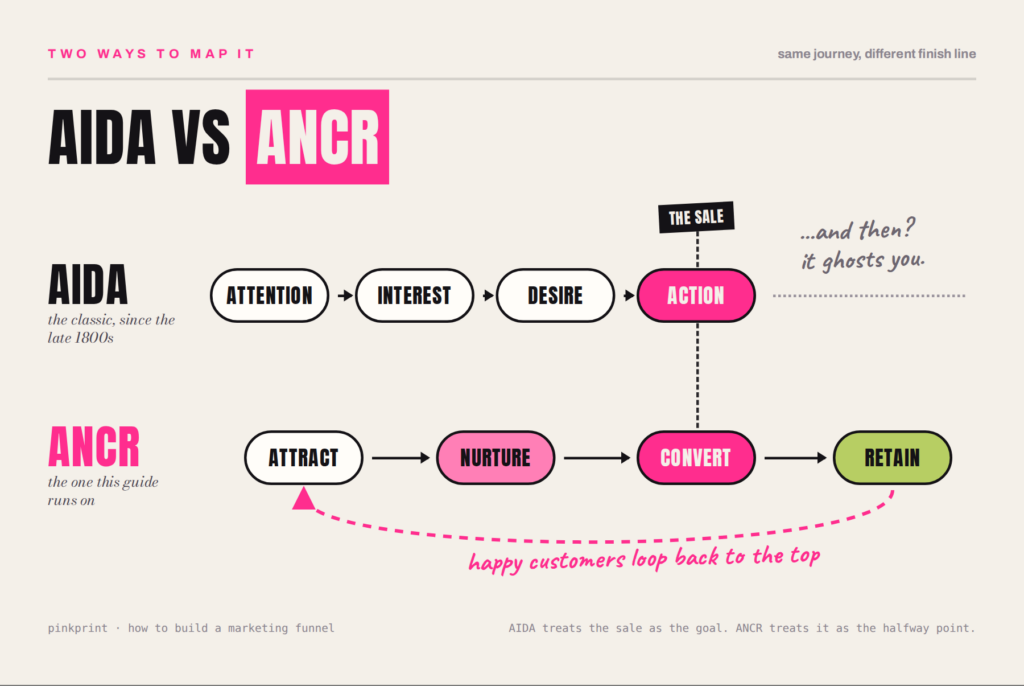
If you’ve ever taken a marketing class or read an old-school advertising book, you’ve met AIDA. Attention, Interest, Desire, Action. It’s the original funnel model, dating back to the late 1800s, and it’s still taught everywhere because the psychology behind it hasn’t really changed. You grab someone’s attention, you build interest, you turn that interest into desire, and desire turns into action, meaning a purchase.
The issue is, AIDA stops the second someone buys, which is where this model falls short. Action is the finish line. Nothing about what happens after, whether they stick around, whether they buy again, whether they tell a friend, is built into the model at all.
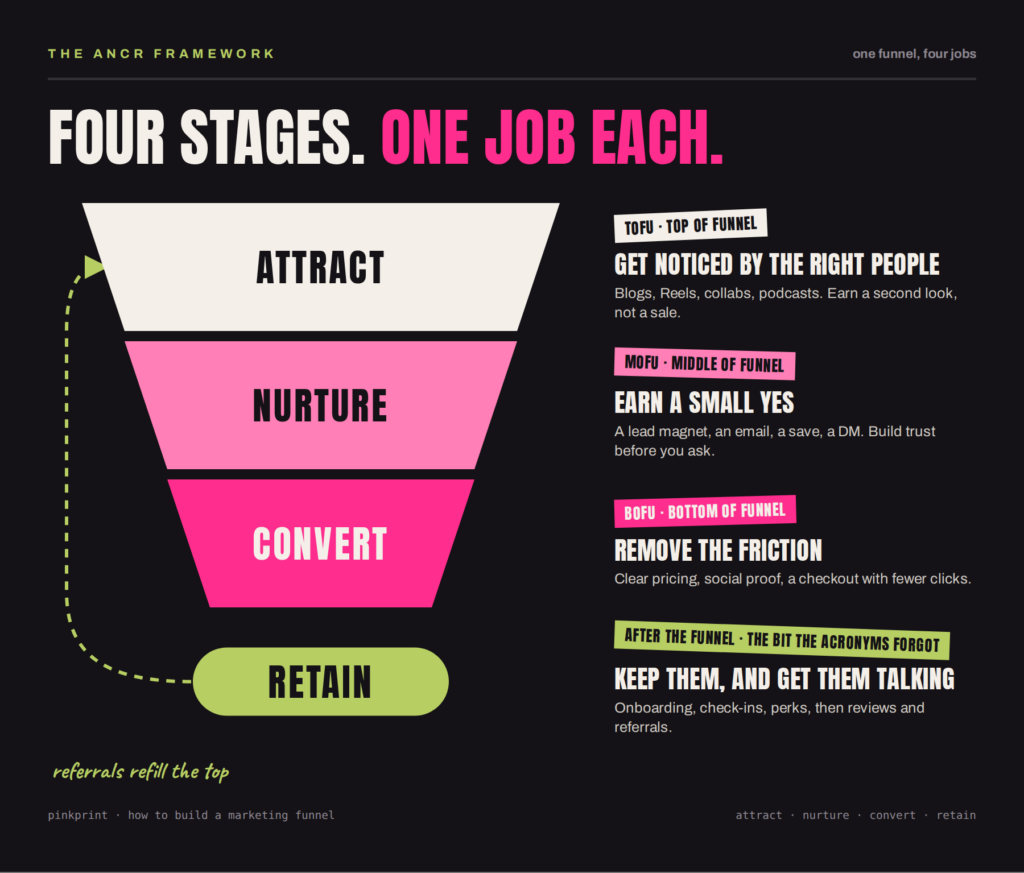
That’s the gap ANCR closes. ANCR stands for Attract, Nurture, Convert, Retain. This framework helps you plan for the aftermath once someone becomes a customer. This means you’re set up with a clear plan to bring those customers back for more.
The real difference between ANCR and AIDA is the finishing line. AIDA treats the sale as the goal. ANCR treats the sale as the halfway point. If you only ever build for AIDA, you’ll keep spending money acquiring the same customers over and over, because nothing in your funnel is designed to keep them once you’ve got them.
This is why, in this guide, we’ll focus on ANCR over AIDA.
A Funnel Is Just a Series of Small Yeses
Now that we’ve got the top-line theory out of the way, there’s something much simpler I want you to remember.
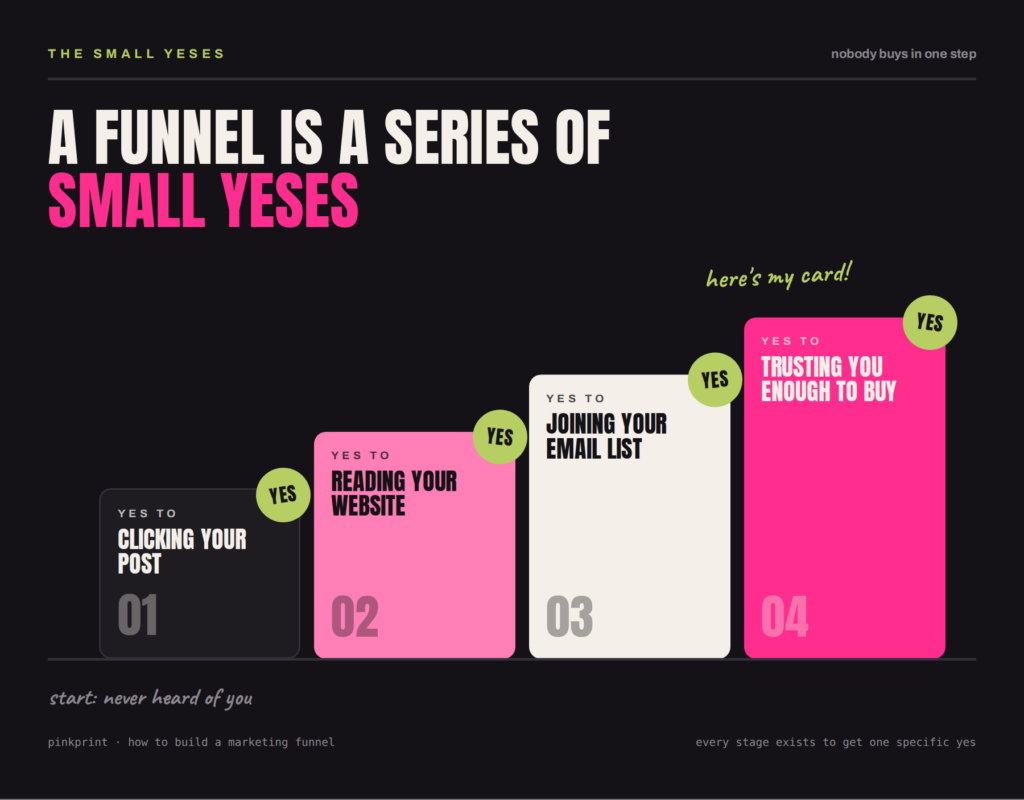
A funnel is a series of small yeses.
- Yes to clicking your post.
- Yes to reading your website.
- Yes to joining your email list.
- Yes to trusting you enough to buy.
Nobody goes from “never heard of you” to “here’s my credit card number” in one step. They go from noticing you exist, to being mildly curious, to actually paying attention, to trusting you a little, to trusting you a lot, to finally being ready to hand over money. Every stage of your funnel exists to get one specific yes out of the person.
Side note. The businesses that get this right almost always talk about their funnel in terms of relationship, not pipeline. Pipeline language treats people like inventory moving through a warehouse. Relationship language treats them like, you know, people. Keep that framing in your head as we go, because it’ll save you from a hundred small mistakes later.
Okay. Back to it.
The Biggest Funnel Mistake: Selling Too Soon
The biggest funnel mistake you can make is trying to sell too early.
If you send a marketing email that’s basically a sales pitch to someone who only found you four seconds ago, it can come off way too “salesy.”
It’s like proposing marriage on a first date. Technically you could do it, but the success rate is not going to be pretty.
Not Every Marketing Funnel Looks the Same
Just like with every marketing theory I come to explain, there’s no one-size-fits-all marketing funnel strategy that works for all businesses.
Quick pause before we get into the stages, because I don’t want you building this in your head as one rigid template that’s supposed to fit every business. It doesn’t. The four funnel stages stay the same: attract, nurture, convert, retain, but the actions change based on what you do.
Okay, real quick side note, because I know someone’s already panic-Googling “what kind of funnel do I even have?” You probably have some Frankenstein mix of two of these, and that’s fine, that’s normal. Nobody’s funnel is a clean textbook example. Moving on.
- Ecommerce funnels live and die by product discovery and repeat purchases. It’s also worth throwing cart abandons in the mix. Your “interest” stage is often a discount code that people can’t resist.
- Service business funnels usually run on lead magnets and real conversations. With these, your big win isn’t always a purchase. It can also be someone just agreeing to have a call with you.
- SaaS funnels typically swap the consultation for a free trial or a demo. You build the trust through product experience, so make it count.
- Coach and consultant funnels tend to nurture leads through email for weeks before ever pitching a higher-ticket offer, because the offer itself needs more trust to justify the price.
You’ll also hear marketers toss around terms like TOFU, MOFU, and BOFU, and it helps to know how these terms translate so you won’t be lost the next time someone uses them in a meeting like a personality trait. TOFU is top of funnel, or Awareness. MOFU is middle of funnel, or Interest. BOFU is bottom of funnel, or Decision. The point about Retention comes after the traditional funnel has ended, and that is actually one of the key reasons why Retention gets overlooked – it isn’t even part of the acronyms people learn.
The process described in this guide is applicable to all of these stages because the roles are always the same regardless of the tools and touch points that have changed. Remember this as you move through the stage descriptions. Just replace your own versions of “consultation,” “free trial,” and “discount code” where appropriate.
Building Your Own Funnel
Stage 1 – Getting Noticed by the Right People
The top of your funnel has one job. Not generate leads. Not build brand awareness. One job. And that’s putting your business in front of the right people. AKA your dream client. Your whole aim is to give them a reason to look twice.
This is where most of your outbound content lives. Blog posts, social content, SEO-driven pages, podcast guest spots, YouTube videos, ads if you’re running them. The list goes on. At this stage, you are not trying to convert anyone. You’re trying to earn a second interaction.
I’d like you to think about this the same way you would think about talking to someone new at a party. You don’t walk up and go “hi, want to move in together?” You say something interesting, you’re a little funny, maybe a little unhinged in a charming way, then you let them decide if they want to keep talking to you. Your awareness content should do exactly the same thing.
Most people don’t discover a business and buy five minutes later. They see an Instagram Reel. A few days later they stumble across a blog. Then they spot you on LinkedIn. A friend mentions your name. Before they know it, you’re familiar. And familiarity builds trust.That’s your job at the awareness stage.
What actually works here:
- Blog posts answering the exact questions your dream clients are Googling.
- Social content that teaches them something or makes them stop scrolling.
- Collaborations and partnerships that introduce you to someone else’s audience.
- YouTube videos that solve a problem.
- Paid ads if they make sense for your business.
Don’t limit yourself to one channel, either. The channel matters less than the fact that you’re showing up somewhere your person is already looking.
The Biggest Mistake at This Stage
The biggest mistake you can make at this stage is treating awareness like a sales brochure. I get why people do it. It feels like you’re killing 2 birds with one stone. Why not introduce yourself and make the sale at the same time? Right? The problem is, you’ve skipped about five yeses in between.
Someone who has never heard of you is not going to hand over their bank details straight away. You need to build trust and familiarity with them first.
Quick gut check before you move on. If you deleted every mention of your product or service from your top-of-funnel content, would it still be worth someone’s time to read or watch? If the answer is no, you’re skipping straight to the pitch, and you’re going to lose people.
Stage 2 – Turning “Noticed” Into “Interested”
Somebody saw your content. Great. Now what? This is the stage most businesses just… don’t build. They have awareness content, and they have a sales page, and there is a canyon in between where potential customers fall off a cliff and disappear forever.
The interest stage is where you deepen the relationship enough that someone is willing to give you something. An email address. A follow with intention, not just an algorithmic accident. A saved post. A DM asking a question. These are all small yeses, and each one is a signal that you’re allowed to keep talking to this person.
This is where lead magnets and email lists come into play, and I know, I know, “lead magnet” sounds so 2015. But the mechanism still works because the psychology behind it hasn’t changed. People are more willing to trust a business that gives them something useful for free before asking for anything in return. And it shows up in the numbers: sign-up-focused landing pages built around a genuine opt-in offer typically convert in the 5 to 20%+ range, according to Leadpages’ 2026 conversion benchmark data, well above what most cold traffic converts at anywhere else in the funnel.
Your lead magnet needs to solve a real problem. Not a fake one you made up to justify the opt-in form. If you’re a copywriter and your freebie is a generic “10 Instagram Caption Templates” PDF that could apply to literally any business, it’s not going to attract people who are actually close to hiring a copywriter. It’s going to attract people who want free templates. Different audience entirely. Nobody’s proud of a list of subscribers who ghost every email, myself included.
Instead, your lead-magnet could be “The 5-Minute Website Audit: Find the One Sentence That’s Losing You Customers.” That title alone filters for people who have a website, who are worried about conversion, who have a clear pain point and who are willing to spend five minutes being a little uncomfortable about their own copy. That’s your person.
What belongs at the interest stage:
- A genuinely useful lead magnet, gated behind an email opt-in
- An email welcome sequence that keeps building trust, not one email that immediately pitches
- Retargeting ads to people who visited your site but didn’t convert (this is different from cold ads because you’re speaking to someone who already knows you exist)
- DM or comment engagement that treats questions as conversations
The Biggest Mistake at This Stage
Quick story time before we move on. Let me tell you about a funnel I watched fall apart from exactly this gap.
A wellness coach I worked with had genuinely gorgeous top-of-funnel content; her Reels were better than half the stuff sitting in my saved folder. But if you liked one and wanted to know more, your only option was “DM me to book a call.” That’s it. No email list. No nurture sequence. Nothing between “I liked your Reel” and “I am now ready to spend money and time on a total stranger,” which, when you say it out loud, is a lot to ask of someone four seconds into knowing you exist.
She was asking for a huge commitment with zero relationship built in between, and her DM-to-client conversion rate showed it. We fixed it by adding one simple step. A free 3-day reset guide in exchange for an email, followed by a five-email sequence that actually taught something in every single email. Her booked calls tripled in two months. Not because her content suddenly got better, it was already great, but because the middle of her funnel finally existed instead of being this weird empty gap she’d been asking people to leap across.
Anyway. Back to the framework.
Stage 3 – Making the Decision Easy
This is the phase that people think of when talking about funnels. The sales page, the pricing table, the checkout flow. This phase is important. Here’s the thing though – by the time someone gets to the decision-making stage, your job isn’t to convince them anymore. If you did your homework in stages one and two correctly, they are convinced already. Your job now is to remove friction.
Side note, I’ve done this to myself more times than I’ll admit. Added something to an online cart, gotten distracted by literally anything else for four seconds, and never go back to actually purchasing. This doesn’t mean that I changed my mind. It just means that the window of opportunity closed, and nothing could pull me back in.
Back to it.
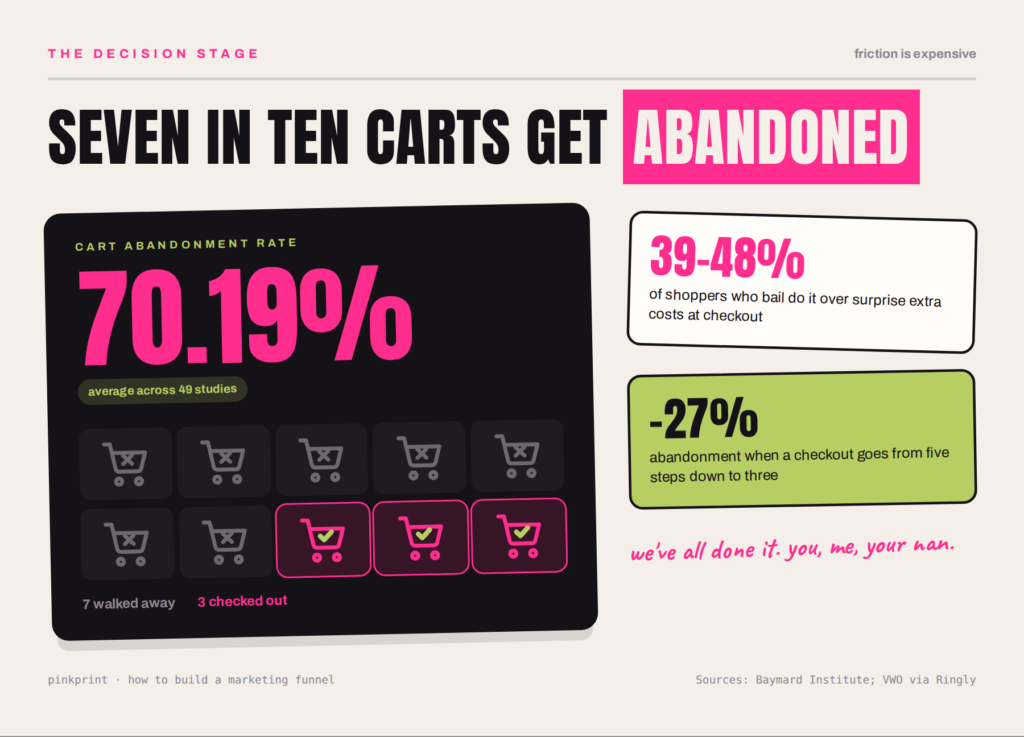
Friction is anything that makes a ready-to-buy person hesitate, second-guess, or close the tab to “think about it,” which we all know is where good intentions go to die. And friction is expensive. The average cart abandonment rate sits at 70.19%, according to Baymard Institute’s meta-analysis of 49 studies, meaning roughly seven out of every ten people who were ready enough to add something to their cart still walked away before paying.
Common friction points, and how to fix each one:
Unclear pricing:
If someone has to schedule a call just to find out how much something costs, you’re increasing the number of steps and filtering out people who were ready to buy but didn’t want to sit through a sales call to get a number. Where you can, show the price, or at least a range. This is even more important at the checkout, stage because unexpected additional costs are unexpected extra costs are the single biggest reason shoppers abandon. Cited by 39-48% of shoppers, depending on the study, again per Baymard’s research. Surprise fees at the end of a purchase break trust fast.
Too many choices:
Three pricing tiers, sure, that’s a proven structure because it lets people compare and anchor. Nine tiers with confusing feature grids? You’ve just handed someone decision fatigue instead of a purchase.
No social proof at the point of decision:
At this stage, you bring in the testimonials and reviews to earn their keep, right next to the buy button.
A checkout process with too many steps:
Every additional field, every extra click, every “are you sure?” pop-up is a chance for someone to change their mind. Cutting a checkout flow from five steps down to three has been shown to reduce abandonment by 27%, per VWO’s optimisation research. Audit your actual checkout flow as a first-time buyer would experience it. Count the clicks. If it’s more than three or four, look for what you can cut.
Stage 4 – What Happens After Someone Buys
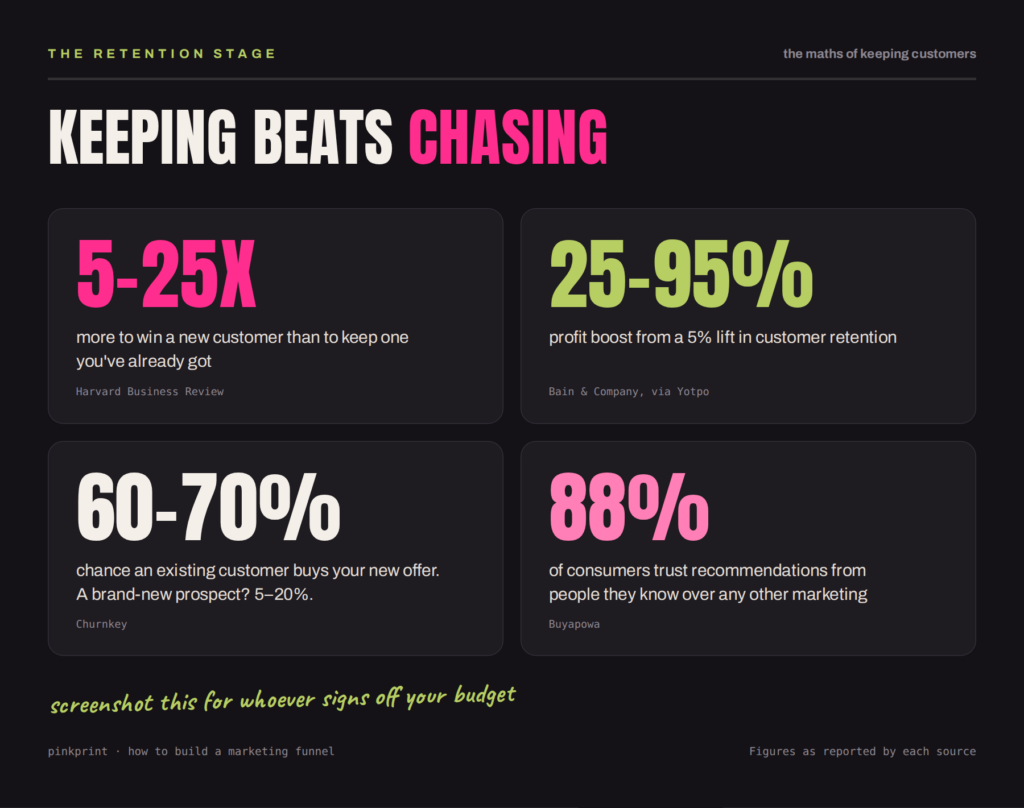
Here’s a stat that should genuinely bother you if your funnel stops at the sale: acquiring a new customer can cost 5 to 25 times more than retaining an existing one, according to Harvard Business Review, yet most funnels are built like the relationship ends the moment the payment clears. That’s not a funnel; that’s a leaky bucket with extra steps. The reason to care goes beyond cost, too: Bain & Company’s research found that a mere 5% increase in customer retention can boost profits by 25% to 95%, and an existing customer converts on a new offer at somewhere around 60-70%, compared to just 5-20% for a brand-new prospect, per industry benchmark data from Churnkey.
The retention stage is where you turn a one-time buyer into a repeat customer, and ideally, into someone who tells other people about you without being asked. This is the part of the funnel that compounds. Every customer you retain and delight becomes a mini top-of-funnel channel of their own, through reviews and word of mouth, which is still, after everything, the most trusted form of marketing that exists. It’s not just a vibe, either: 88% of consumers say they trust recommendations from people they know above every other form of marketing, which is exactly why a happy retained customer is worth more than the sale they just made.
What retention actually looks like in practice:
- A genuinely good onboarding experience for whatever you sold, so the customer actually gets the result they paid for, because a customer who gets results is a customer who stays and talks
- A follow-up sequence that checks in without immediately pitching the next thing
- Exclusive content, early access, or loyalty perks for existing customers, so being a repeat customer actually feels different from being a new one
- A simple, low-friction way to ask for reviews or referrals once you know someone’s had a good experience, not before
I want to flag something here because it trips people up.
Retention marketing should not feel like more of the same sales content you used to acquire them. Someone who already bought from you doesn’t need to be convinced you’re credible anymore. They need to feel like buying was the right call, and like sticking around gets them something new.
Funnel vs. Flywheel: Are Funnels Dead?
“Funnels are dead”
That’s the hook many marketers latch on to because apparently no marketing concept is allowed to just exist anymore. It has to be dead or replaced by “the next big thing.” Cue the LinkedIn hot take discourse.
I would like to preface that funnels are very much alive. But businesses should be thinking about flywheels too.
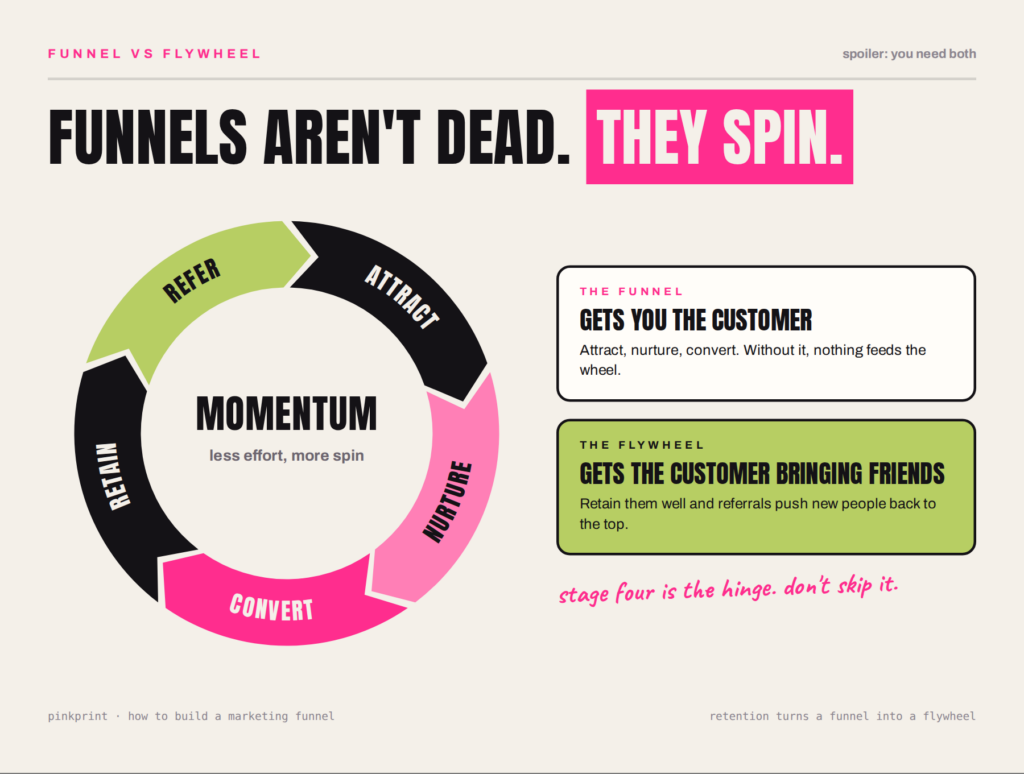
A flywheel is what happens when that customer journey works so well that your existing customers start helping you create new ones. That momentum starts spinning the whole system faster, with less effort from you.
Your funnel is what acquires the customer in the first place. Retention is what turns that funnel into a flywheel. You need both. A flywheel with nothing feeding it eventually slows down, and a funnel that never turns into a flywheel means you’re stuck buying every single customer from scratch, forever. Stage four of this whole guide is the hinge point between the two.
People Rarely Buy After One Touchpoint
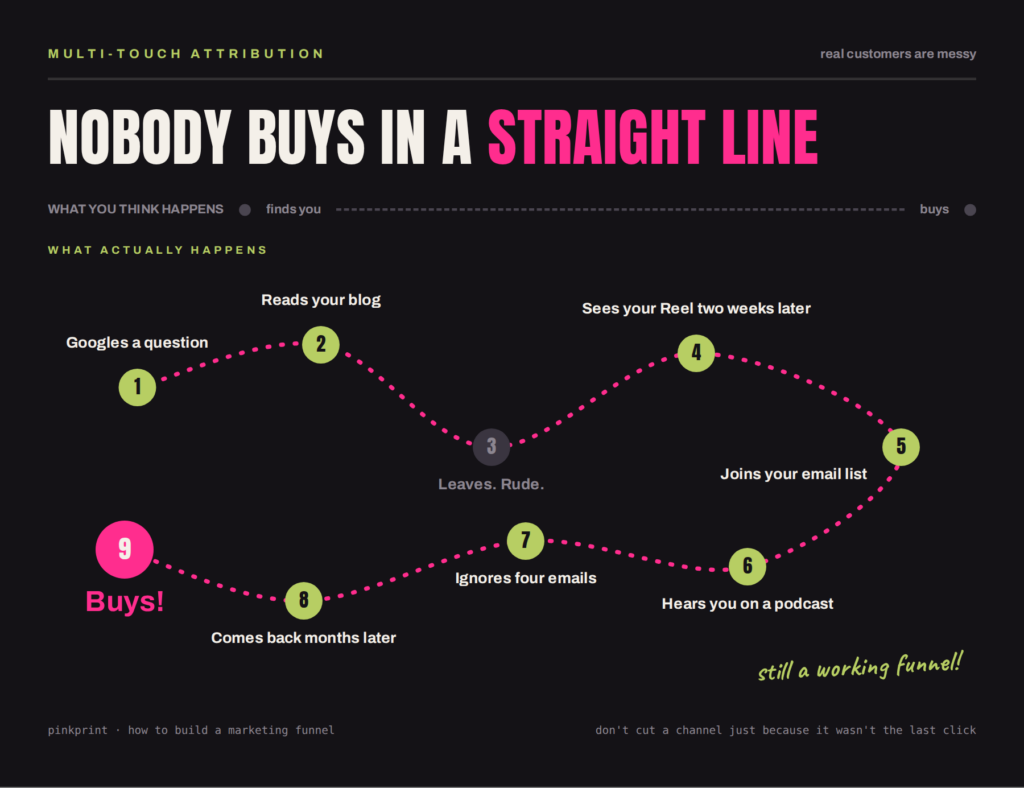
Before I get into how to build your own funnel, it’s important to note that your funnel will never be a single, tidy path where someone discovers you on Monday and buys from you on Tuesday. Real customers are much messier than that. Someone might find you through Google, read a blog post, leave, see your Instagram content two weeks later, join your email list, hear you on a podcast and finally come back months later ready to buy.
That’s not a broken funnel. That’s a normal one. Multi-touch attribution is worth understanding even at a basic level so you don’t cut a channel that’s quietly doing work in the middle of someone’s journey, just because it wasn’t the final click.
Mapping Your Own Funnel, Step by Step
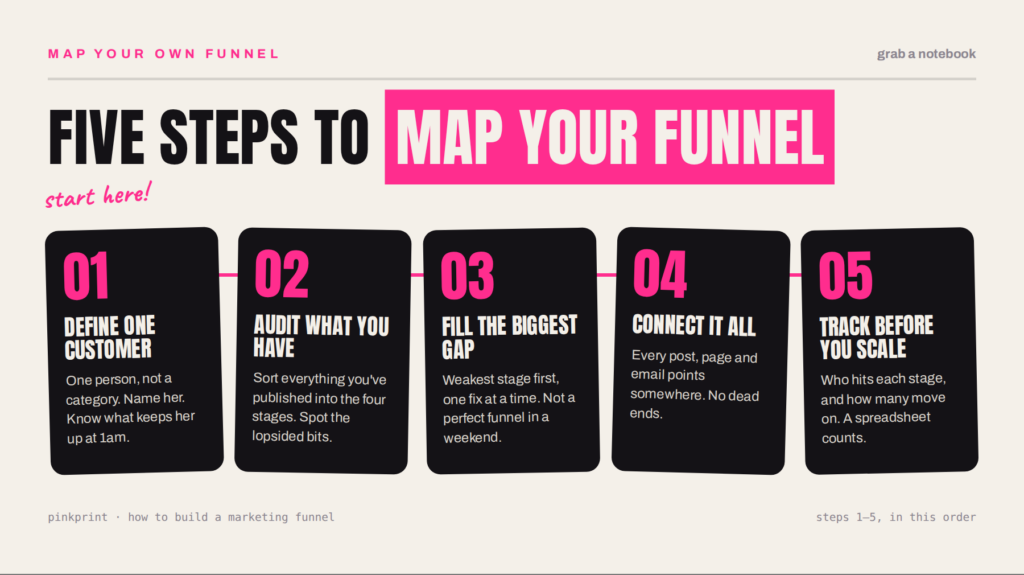
Okay, theory’s done. Let’s actually build yours. Grab a notebook, a Notion doc, whatever, and work through this in order.
Step 1 – Define one specific customer.
Not “small business owners.” One person. What’s keeping them up at night? What have they already tried that didn’t work? What would make them trust a stranger enough to hand over money? If you can’t answer these with specificity, stop and figure this out before touching anything else, because every stage of your funnel depends on knowing exactly who you’re talking to.
This is basically building a customer persona. Give this person a name, an age range, a job or life situation, and then answer the questions above like you’re describing an actual human, not a demographic.
The tighter this persona is, the easier every other decision in your funnel becomes. Your lead magnet writes itself when you know what your ideal client has already tried and failed at. Vague personas produce vague funnels, and vague funnels don’t convert anyone because they’re not actually talking to anyone. They’re talking at a category.
Step 2 – Audit what you currently have:
List every piece of content you’ve already published. Sort them into the four stages: awareness, interest, decision, retention. I promise you, almost every business I’ve ever looked at has a funnel that’s lopsided, usually stacked with awareness content and almost nothing in interest or retention. Seeing the gap on paper is half the battle.
Step 3 – Fill the biggest gap first:
Don’t try to build a perfect four-stage funnel in one weekend. Find your weakest stage and fix that one thing. If you’ve got great content but no email list, build the lead magnet and the opt-in this week. If you’ve got leads but no nurture sequence, write five emails this week. One fix at a time, in order of impact.
Step 4 – Build the connective tissue:
Every piece of content should point somewhere. Your blog post should link to your lead magnet. Your lead magnet’s thank-you page should point to your best-selling offer or your booking link. Your welcome email should set up the eventual pitch instead of springing it out of nowhere. Nothing in your funnel should be a dead end.
Step 5 – Set up tracking before you scale anything.
You cannot fix what you can’t see. At minimum, track how many people hit each stage, and what percentage moves to the next one. Even a simple spreadsheet updated weekly beats a beautiful funnel you’re flying blind on.
Real-World Funnel Examples
Theory’s useful, but nothing makes a funnel click like watching one play out start to finish. Here are three, in different flavours, so you can see how the same four jobs show up in completely different businesses.
Coffee shop (local, in-person business): Instagram Reel → Google Business Profile visit → 10% discount email signup → in-store visit → loyalty card → referral reward.
Service business (consultations and higher-ticket offers): Blog post → lead magnet → email nurture sequence → consultation call → client → review request → referral.
Tying it all together (the version most online businesses actually run): Google search → blog post → free checklist → email series → book a call → client → monthly newsletter → referral → new prospect discovers you the same way the last one did.
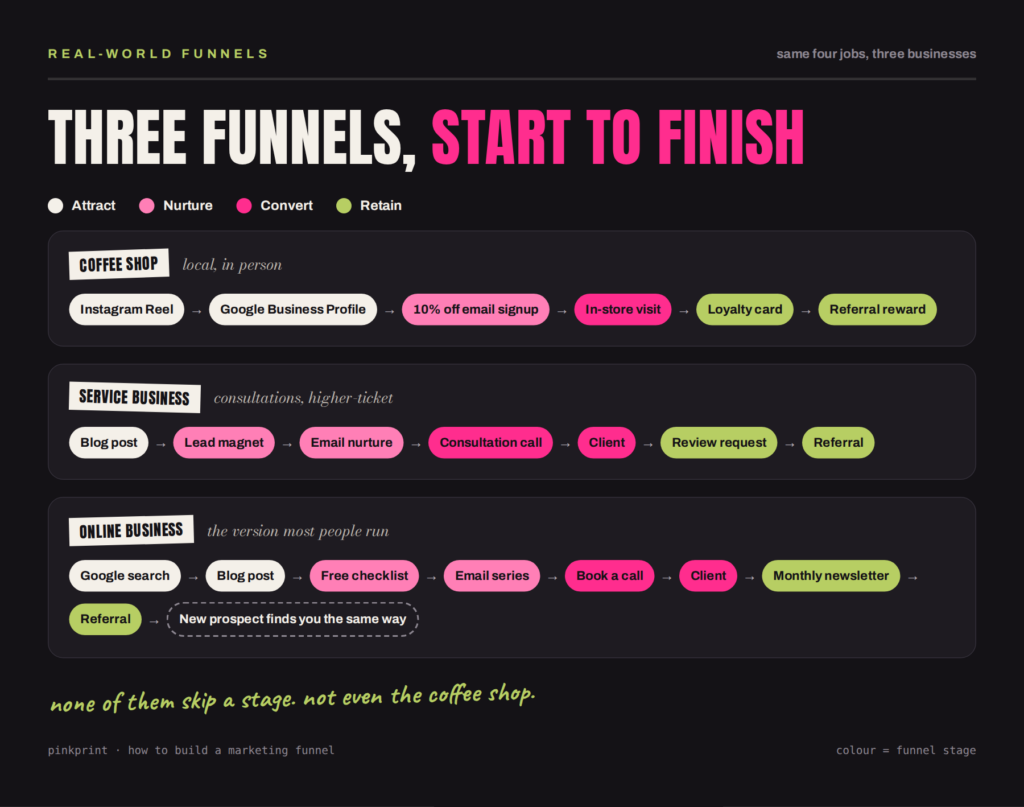
Notice that none of these skips a stage. Even the coffee shop, which feels the most casual of the three, still has an awareness moment (the Reel), an interest moment (the discount signup), a decision moment (the in-store visit), and a retention moment (the loyalty card and referral reward). Map your own business against one of these and see which link in the chain is missing.
The Metrics That Actually Tell You Something
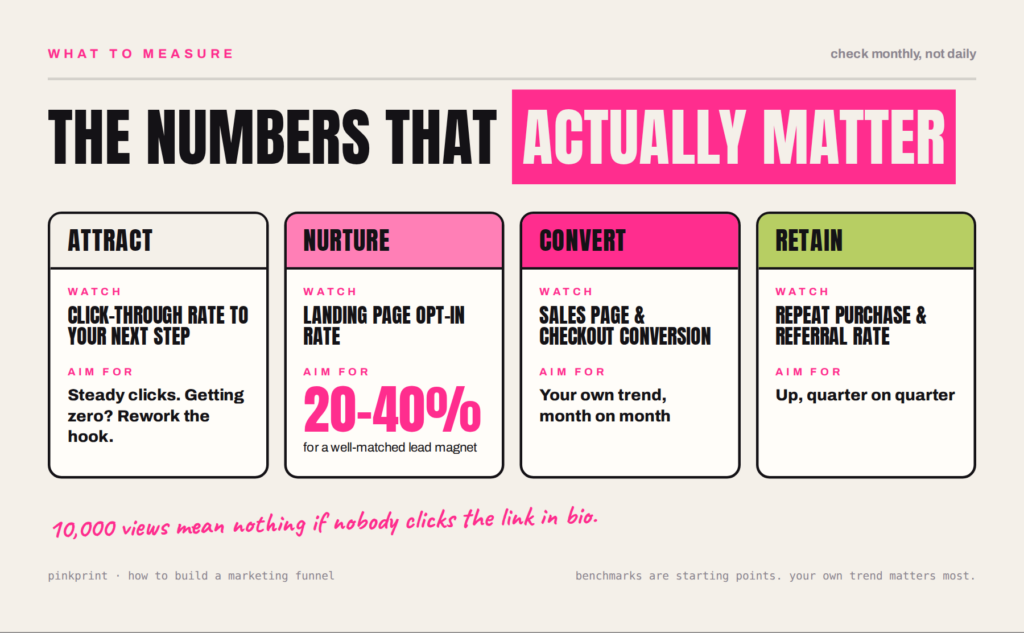
Here are the metrics to look out for
| Stage | What to Watch | Healthy Benchmark |
| Awareness | Click-through rate to your next step | Varies by channel, but if a piece of content isn’t driving clicks at all, that’s your signal |
| Interest | Landing page opt-in rate | 20-40% for a well-matched lead magnet |
| Decision | Sales page and checkout conversion rate | Varies heavily by price point and industry; watch your own trend over time more than any external number |
| Retention | Repeat purchase rate and referral rate | Industry-dependent, but any upward trend quarter over quarter is a good sign |
At the awareness stage, track reach and engagement rate, but really watch click-through rate to your next step. Ten thousand views on a Reel means nothing if nobody clicks the link in bio.
At the interest stage, watch your opt-in conversion rate, meaning what percentage of people who land on your lead magnet page actually give you their email. Anything under about 20% usually means your offer or your headline needs work, not your traffic.
At the decision stage, watch your sales page conversion rate and, just as importantly, where people are dropping off in your checkout flow. If everyone’s abandoning at the same step, that step has friction you need to remove.
At the retention stage, watch repeat purchase rate and referral rate. These are the numbers that tell you whether you’re building a business or just running a series of one-night stands with strangers’ credit cards.
Check these monthly, not daily. Funnel data needs enough volume to mean anything, and checking it obsessively every morning is a fast way to make panicked decisions based on statistical noise.
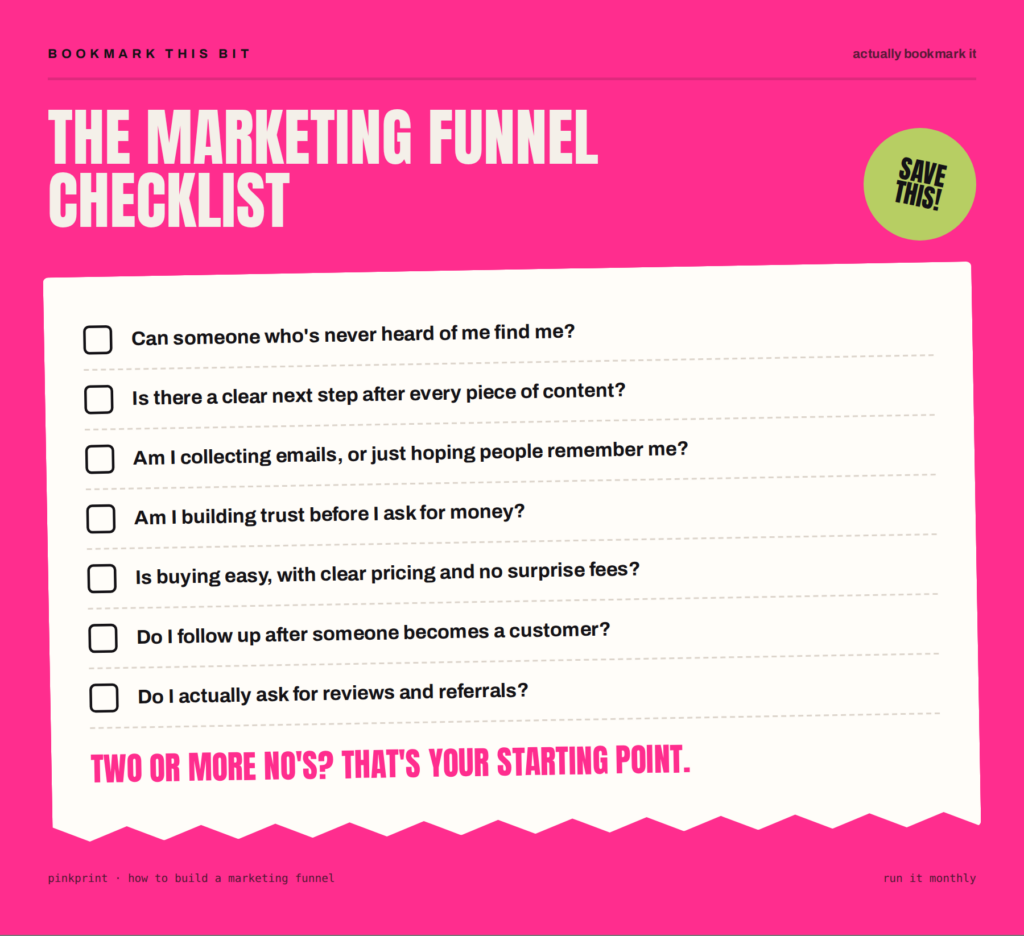
The Marketing Funnel Checklist
Bookmark this part. Actually bookmark it, don’t just say you will. Run through it any time you want a fast read on where your funnel actually stands.
- Can someone discover me who’s never heard of me before?
- Is there a clear next step after every single piece of content?
- Am I actually collecting emails, or just hoping people remember me?
- Is trust being built before I ever ask for money?
- Is buying genuinely easy, with pricing clear and friction removed?
- Do I follow up after someone becomes a customer?
- Do I ever actually ask for reviews or referrals?
If you answered no to more than two of these, you’ve just found your starting point.
Marketing Funnel Myths
A few things people believe about funnels that just aren’t true. Consider this me gently taking the phone out of your hand before you spiral.
“My funnel needs automation.” No. Automation makes an already-working funnel more efficient. It won’t fix a funnel that’s broken to begin with, and plenty of small businesses run great funnels manually for years before automating anything.
“I need paid ads.” No. We’ll get to this properly in the FAQ, but organic content and referrals can carry a full funnel on their own.
“I need thousands of followers.” No. A tiny, trusting audience converts better than a huge, indifferent one. Depth beats reach at every stage of this framework.
“My funnel should sell immediately.” No. If it’s selling immediately, you’ve skipped stages, and you’re only capturing the small slice of people who were already sold before they found you.
Marketing Funnels in the Age of AI Search
Search has changed. A lot.
I recently broke down what that means for SEO and content visibility in my guide: What Is GEO (Generative Engine Optimisation) and Why Your SEO Plan Needs It. But the short version? People aren’t discovering businesses in the same predictable way they used to.
And that has a direct impact on your funnel.
Someone might find you through ChatGPT, click through to your website, join your email list, disappear for three weeks, then come back through a Google search when they’re finally ready to buy.
What that means practically: your funnel needs to assume people can enter at different points instead of expecting everyone to start neatly at “awareness” and march through in order. It also means the same qualities that make content genuinely useful to a human, clear structure, real answers, no fluff – are exactly what make it more likely to get pulled into an AI-generated answer in the first place. Building a funnel that respects the reader is, conveniently, also the version that performs better in this new kind of search.
The Bottom Line
If there’s one thing I want you to walk away with, it’s this: a funnel that converts is the one that respects how people actually make decisions, slowly, with growing trust, one small yes at a time. Build content for strangers that doesn’t ask them for anything yet. Build a bridge for interested people that deepens the relationship. Remove every unnecessary bit of friction for people who are ready to buy. And actually take care of people once they’re customers, because that’s where the real compounding growth lives.
You don’t need to build all four stages perfectly this month. You need to know which stage is weakest, and go fix that one thing. That’s the whole game. Text me when it works; I mean it.
Marketing Funnel FAQ
How long should a marketing funnel take to build?
The first version doesn’t need to be elaborate. A basic four-stage funnel, one or two awareness content types, one lead magnet, one welcome sequence, and a clear sales page, can realistically be built in two to four weeks if you’re focused. The real mistake is perfectionism. Launch the basic version, then improve it with real data.
Do I need paid ads to have a working funnel?
No. Plenty of strong funnels run entirely on organic content. Paid ads are a nice-to-have that can accelerate a funnel that’s already converting, but they’ll also amplify a broken. Fix the funnel first, then consider paid traffic.
What’s the difference between a funnel and a customer journey?
They overlap a lot, but a funnel is usually the marketer’s-eye view, the structured stages you build to move people toward a purchase. The customer journey is the messier, real-world version of what an actual person experiences, which rarely moves in a straight line. Building your funnel with the customer journey in mind, meaning accepting that people bounce between stages, is what keeps a funnel from feeling robotic.
What’s the difference between a sales funnel, a lead generation funnel, and a marketing funnel?
People use these terms loosely, but generally a marketing funnel is the broadest, covering everything from first discovery to retention. A lead generation funnel usually focuses narrowly on the awareness-to-interest handoff, getting someone from stranger to lead. A sales funnel usually starts once someone’s already a lead and focuses on the decision stage. This guide’s four-stage framework covers all three, just under one roof.
Are funnels dead? Should I be building a flywheel instead?
Neither is dead, and it’s not really an either-or. Your funnel acquires the customer. Your retention stage, done well, turns that funnel into a flywheel where happy customers bring you new ones. You need the funnel to get the flywheel spinning in the first place.
How often should I update my funnel?
Review it quarterly at minimum. Anytime you launch a new offer, change your pricing, or notice a stage underperforming in your metrics, that’s also a trigger to go back in and adjust.
What if I only have time to fix one stage right now?
Fix whichever stage has the biggest drop-off in your numbers. If you don’t have numbers yet, the interest stage is the most commonly neglected one, so start there. A lead magnet and a five-email welcome sequence will do more for most funnels than another month of top-of-funnel content alone.
