want expert advice on your website? get in touch for a free website audit
book your free website audit



What Is GEO (Generative Engine Optimisation) and Why Your SEO Plan Needs It
July 7, 2026
Quick question: When was the last time you actually scrolled past an AI-generated answer to click through to a website? Yeah. Thought so.
Search as we know it is currently going through a massive reshuffling, and it’s changing right before our eyes. More than ever before, users are turning away from traditional articles and opting to find their answers instantly through AI. This is where GEO (Generative Engine Optimisation) comes into play. It’s the new “it girl” of SEO, and unfortunately, not everyone’s actually doing anything about it.
So let’s fix that.
First Things First: What Even Is GEO?
In one sentence? GEO is the practice of optimising your content so AI-driven search engines and answer surfaces select it and cite it as a credible source.
Simple in theory. A lot messier in practice, because most brands are still writing content for a search engine that, frankly, doesn’t work like it used to.
Why GEO Matters Now?
Ranking on search engines isn’t about keyword-matching anymore. It’s evolved. Generative models such as Google AI Overviews and ChatGPT pull together quick and easy answers straight from web content, and if your pages aren’t built for that, you no longer exist on the results page. If the AI doesn’t pick you as the source of truth, you risk losing visibility and referral traffic, even if you’re still technically “ranking.” Why? Because AI models aren’t looking for the highest-ranking sites on the web. They’re looking for the most credible content.
Key thing to note: GEO isn’t just about ChatGPT. It’s about making your content discoverable across the whole ecosystem of AI-powered search experiences – Google AI Overviews, ChatGPT Search, Perplexity, Claude, Microsoft Copilot and other LLM-powered assistants that retrieve and summarise web content.
And that ecosystem is only growing. Which means the brands sorting this out now are the ones who’ll still be visible in two years. The ones who ignore it? Not so much.
GEO and SEO
Differences Between GEO and SEO
So, what’s the difference between SEO and GEO? Well, here’s the actual breakdown:
- Intent: GEO targets the exact format generative engines love (concise explanations, steps, comparisons). SEO plays the long-haul game across broader search intent.
- Source Quality: Generative AI models are obsessed with authority and evidence. If what you’re putting out isn’t credible, AI engines won’t even touch your content. That’s why it’s important to take extra care in building your topical authority.
- Structure: You might have guessed by now that the name of the game with AI models is clear answers delivered fast. Which is why your structure needs to be on point. Clean headings and short, snappy paragraphs make it easier for the AI to scan and grab information quickly to use as their source.
- Answer-ready snippets: GEO wants complete, standalone answers a model can lift and reuse. No fluff, no rambling.
The best part? You don’t have to pick just one strategy between the two. GEO and SEO work together. Strong SEO builds your broad authority, and GEO makes sure the AI engines actually notice.
Similarities Between GEO and SEO
There are many similarities between GEO and SEO. Both are chasing the same end goal: getting your content in front of the right person at the right moment. Both live and die by authority, relevance and technical health (crawlability, site speed, clean structure – none of that goes away just because AI’s involved). Both reward content that’s genuinely useful over content that’s just… there. And both require ongoing maintenance, not a one-and-done fix. If you’ve already got solid SEO fundamentals in place, you’re building on top of what you’ve got.
How GEO Actually Works – The Key Concepts
AI Retrieval
This is where we put our technical hats on to understand how this all works. The first step is to understand AI Retrieval. Before an AI can answer some questions, it may first need to find relevant information. This process is called AI retrieval and is one of the biggest reasons GEO matters.
AI assistants like ChatGPT and Claude don’t scour the entire web every time someone asks a question. That would take forever. Instead, they retrieve the most relevant pieces of information from a huge collection of indexed content before generating an answer.
Quick clarification, because this trips a lot of people up: “indexed content” doesn’t just mean a mirror of Google’s index. Depending on the system, that pool can include standard web pages, structured datasets, cached content, knowledge graphs and sometimes curated corpora or third-party APIs.
For example, someone asks:
“What are the best honeymoon destinations?”
The AI will then go through its indexed sources to find relevant information to help generate a list of recommended honeymoon destinations.
If your content isn’t among those retrieved sources, it has virtually no chance of influencing the answer.
Retrieval vs. Ranking vs. Generation: The Full Pipeline
Here’s the concept that ties this whole section together, and honestly, the one most GEO explainers skip entirely. It’s easy to assume the process is just “AI retrieves stuff → generates an answer.” In reality, there are three distinct stages:
- Retrieval — the system finds a pool of documents (or chunks – more on that in a sec) that are broadly relevant to the query.
- Ranking — from that pool, the system decides which pieces are actually the best candidates, based on a bunch of scoring signals.
- Generation — the model writes the final answer, drawing on the highest-ranked pieces as its grounding.
Retrieval captures the content. Ranking decides what’s worth keeping. Generation is what the reader actually sees. GEO touches all three stages, but a lot of brands only think about the first one – getting found in the first place. But getting found is just step one. You still have to be considered a strong enough source to be put in front of users’ eyes. That’s why I heavily emphasise the need to build up authority in your space.
Semantic Retrieval
Unlike traditional search engines, retrieval doesn’t rely on matching content to the exact keywords someone typed. Modern AI uses semantic retrieval, which means it looks for content that matches the intent and meaning behind the question.
Here’s how: AI turns every document into a mathematical representation called an embedding. These embeddings are stored in specialised databases called vector databases, which lets AI systems search by meaning instead of keywords.
Instead of storing words, it stores meaning. When someone asks a question, the AI compares the meaning of that question against millions of stored embeddings and retrieves the closest matches.
For example, your article might say:
“Automating invoice processing reduces the time spent on manual bookkeeping.”
A user might ask:
“How can I spend less time entering invoices?”
Even though neither uses the exact same wording, the AI recognises they’re talking about the same concept and retrieves your content anyway. This is because it understands the relationship between similar ideas.
Entity Optimisation:
Building off what we discussed above about Semantic Retrieval, and linking to the fact that AI looks beyond keywords, as opposed to traditional SEO – search engines increasingly think in entities, not keywords.
So… what actually is an entity?
Think of it as any recognisable “thing” that AI understands as its own concept. That could be a brand, a person, a product, a place or even a broader idea.
So, instead of matching the phrase “best accounting software,” the AI understands entities like:
- Xero
- QuickBooks
- Sage
- bookkeeping
- VAT
- Making Tax Digital
And it understands how those entities relate to each other, too, which is why it’s key to connect related entities throughout your content to strengthen your topical authority and understanding. If keyword stuffing was the old strategy, entity richness is the new one.
You may also like: What is Topical Authority in SEO!
A quick checklist for yourself to make sure you’ve added enough entities:
- Have you explained the actual tools or products people in this space would use? This doesn’t mean you’ve just described them. Instead, you’ve gone into the pros and cons as well.
- Did you mention relevant standards, regulations, or frameworks by their real name?
- Are your competitors or comparable options named directly, rather than dancing around them with “other options on the market”?
- Does your terminology match how an actual expert would talk, not how a beginner would Google it?
- If you deleted every entity and just read the general structure of the page, would it read like any of your competitor’s content? (If yes, you need more entities.)
Name-dropping entities throughout your content is the difference-maker in making any content feel like it’s been written by an expert. AI models are built to notice that difference, even if a casual reader might not consciously clock it.
Chunking – Why AI Doesn’t Retrieve Whole Pages
Chunking is genuinely one of the most important (and most overlooked) GEO concepts. So stay with me.
AI systems don’t retrieve entire articles. They retrieve chunks, which are individual sections, broken out from the source page. When your content gets indexed, it’s not stored as one big block; it’s sliced into smaller, self-contained pieces first, and each of those pieces gets its own embedding.
This changes everything about how you should structure content. It means:
- Headings matter enormously — they act as natural chunk boundaries and tell the system what each section is actually about.
- Paragraph clarity matters — a paragraph that only makes sense in the context of three paragraphs before it is a paragraph is hard for an AI to use in isolation.
- Self-contained answers matter — if a chunk needs the rest of the page to make sense, it’s far less useful to a retrieval system than one that stands on its own.
Basically: stop thinking of your article as one flowing piece of prose that happens to have headings in it. Start thinking of it as a series of individually retrievable, self-contained units that happen to sit on the same page.
Query Fan-Out and RAG
When you ask AI a question, it doesn’t usually stop at the first source it finds.
Instead, it gets sent out to a bunch of different sources at once. And this can be anything from simple articles to full-blown technical reports that are all getting scanned in parallel. Each source throws back its best matches; they get scored, duplicates get cut, and the strongest ones are kept.
That’s called query fan-out.
The next step is RAG, which stands for Retrieval-Augmented Generation. This is where AI takes all of those relevant pieces of information it’s found and uses them to build its answer.
This is where it gets really interesting. It means the model isn’t just making stuff up as it goes along. It’s looking for receipts to back up its answers around the information it’s just found. That leads to fewer hallucinations and more accurate responses.
Combine Query fan-out and RAG together, and you’ve got a system that’s both broad and precise, which is exactly why well-structured, evidence-backed content is what’s winning right now.
But Why Does AI Pick One Source Over Another?
Okay, so now you know how retrieval works. But here’s the question everyone actually wants answered: Why does the AI pick your competitor’s page instead of yours, when you’re both talking about the same thing?
It comes down to three things, really: relevance, trust, extractability.
- Relevance – This is how closely the content’s meaning matches the query intent, and how semantically similar it is to what’s being asked.
- Trust – Authority signals, consistency with other established sources and how recent the information is.
- Extractability – How easily an answer can be pulled straight from the content without the model having to do any rewriting or interpreting.
You definitely don’t need to get your head around the maths behind all of this. Just know that every source will be scored against these 3 pillars before ranking decides who makes the final cut. That means your job behind the scenes is to ask yourself: how relevant your content is to the question, how closely it matches the meaning, whether it’s a trustworthy source, how up to date it is and how easy it is to pull information from.
Extractability Deserves Its Own Spotlight
Out of the three, extractability is doing way more heavy lifting than people realise. So, let’s give it its own moment.
Extractability is the idea that AI extracts usable sentences from the content it’s reviewing, as opposed to simply ranking it. And that completely changes what “good writing” looks like for GEO.
AI models love content they can quote as-is. If they have to untangle your sentence or rewrite half of it before it makes sense, you’ve already made their job harder. So you need to be straight to the point and remove any fluff. A clear sentence that answers the question straight away is way more likely to get picked than a paragraph that takes the scenic route before finally getting to the point.
The tricky part is that this can sometimes feel like it’s working against good storytelling. Brands naturally want to inject personality to sound human, and that’s still important. The goal isn’t to strip all of that away. It’s about finding the right balance where your content has personality and extractable content.
The Freshness vs. Authority Debate
One nuance worth talking about is that freshness and authority seem to be in a constant battle, where the AI is the referee who needs to ease the tension when they clash.
The harsh reality is that sometimes newer content will outrank a more established source. Why? Simply because it reflects more current information and the older piece hasn’t been updated.
Other times, the opposite happens. A long-standing, trusted source will win out over something newer but weaker, because authority carries more weight than recency.
There isn’t a fixed formula here. The safest move is to make sure you’re strong on both fronts at once. You shouldn’t rely on one to compensate for the other.
Why EEAT Matters More Than Ever
As you can probably guess from the subheading, EEAT matters more than ever.
EEAT (Experience, Expertise, Authoritativeness, Trustworthiness) has been a Google ranking factor for a while now, and is more relevant than ever with GEO.
Quick rundown in case you’re new here: EEAT comes straight from Google’s own Search Quality Rater Guidelines, which is basically Google’s rulebook they use to judge whether the content is actually worth trusting. It breaks down into four components:
- Experience – Has whoever wrote this actually done the thing they’re talking about, not just read about it?
- Expertise – Do they genuinely know their stuff on this topic?
- Authoritativeness – Are they (or the site) recognised as a credible voice in this space?
- Trustworthiness – Is the content accurate to actually rely on?
Google’s been leaning on this since 2014, and it’s not just some throwaway guideline buried in a PDF that nobody reads. It’s Google’s manual to decide what’s worth ranking. This is why thin content has been getting quietly filtered out for years.
This is also where SEO and GEO tie together directly. Good EEAT has always mattered for rankings. Now with GEO, it’s a must-have in your content writing strategy. It’s also the difference between an AI model trusting your content enough to cite it, or just… not. You could have the most beautifully structured page on the internet, and if the trust signals aren’t there, it’s simply not making the cut.
Practically, here’s what that looks like:
Author bios need to actually say something. “Written by the Marketing Team” isn’t going to cut it anymore, and honestly, it never should have. Name the person. Add their credentials. Link to their LinkedIn. Drop a line on why they’re actually qualified to write on this topic. It’s a small change with a huge payoff.
Do the same for any stats you cite too. Link back to the original source instead of just dropping a number and moving on, as it adds to the credibility of your content. And it only costs you thirty seconds but buys you some real credibility.
AI Visibility Isn’t the Same as Ranking
Ranking and AI visibility are two separate things that you need to wrap your head around.
- Ranking is your website’s position on a traditional Google Search Engine Results Page, aka SERP.
- AI visibility is whether you’re actually being used inside a generated answer.
You can rank well and still have zero AI visibility, because the model chose a different, better-structured or more extractable source to actually quote from. And in theory, you could have strong AI visibility on a query where your traditional ranking is fairly average.
The Core GEO Tactics You Actually Need to Apply
Now you know how GEO works; it’s now time to start applying it to your website. Here’s your recipe for success:
1. Answer-first paragraphs – Open every section with a clean, direct answer. This makes it easier for the AI model to identify what your article is about. Save the storytelling for later.
2. Correct structure – Structure your content in a way that makes sense to the AI. Speak their language. FAQs, how-to markup, technical schemas. This is how you help the machines actually understand what you’re saying. Here’s how to structure your content linking back to the retrieval mechanics you just learned:
- Headings improve chunking as they give the system identifiable boundaries to slice your content along.
- FAQs are definitely an underrated part of any blog. They tend to mirror the exact phrasing people type into AI tools, so they’re far more likely to get put straight into a response.
- Lists improve extractability. Each point is already a clean, standalone chunk, ready to be lifted.
- Definitions become citation candidates almost automatically, because they’re inherently self-contained answers.
3. Add credibility – Cite reputable sources. Vague claims are an instant red flag to a generative engine.
4. Comparison tables – Tables are exactly the kind of thing AI engines eat for breakfast. Give them something clean to actually extract, and they’ll take it every time. Instead of digging through paragraphs of dense text trying to piece together an answer, AI can just scan the structure and pull exactly what it needs.
5. Fresh data – Make sure you’re keeping your information fresh and current. Outdated content often gets skipped.
Originality: The Most Underrated Tactic:
Originality is one of the biggest tactics in GEO that most people are sleeping on. Thousands of blogs are out there saying “use headings” and “add FAQs.” AI already has plenty of content they can retrieve from that already does that. What it doesn’t have is information nobody else has published.
That means leaning into:
- Proprietary data
- Surveys
- Internal research
- Case studies
- Unique frameworks
- First-hand experience and reviews
- White-papers
If your content is just a well-formatted version of what’s already out there, you’re competing with a thousand other well-formatted versions. Original insight is what actually gets you noticed and cited, because the AI physically cannot generate it from anywhere else.
Even something as simple as running a small internal survey: “we asked 200 of our customers X,” instantly gives you a statistic nobody else has. Publish it with real numbers, and you’ve created a citable data point that other sites (and AI models) will start referencing back to you. The trick is to stop asking “What should I write?” and start asking “What can I add that the internet doesn’t already know?” If ChatGPT could’ve written it without your input, it’s probably not original enough.
The Pitfalls to Avoid
- Over-optimisation. Keyword stuffing is giving 2012 SEO energy. Generative engines want natural, authoritative phrasing.
- Shallow content is another pitfall to avoid. Avoid the vague claims. Opt for detail and verifiability.
- Messy structure will get you ignored by almost all AI models.
- Old stats, old visibility. That’s the whole equation.
Don’t Sleep on Crawlability
It’s the number one pitfall a lot of brands don’t see coming: it doesn’t matter how good your content is if the bots can’t actually access it. Here’s a checklist so you don’t miss a thing:
- Start with your robots.txt file. It’s one of the first places AI crawlers look, so make sure you haven’t accidentally blocked them from accessing your content. It’s more common than you’d think.
- Next, make sure your content is easy to crawl. AI bots much prefer pages that are fully loaded when they arrive. If your website relies heavily on JavaScript to build the page after it loads, some crawlers might struggle to see everything. Server-side rendered or pre-rendered pages tend to work much better.
- If you use paywalls or gated content, try not to hide everything. If you are going to use gated content, at least let the meta data and summaries through so crawlers know what’s there.
- Finally, you might come across something called llms.txt. It’s a newer file that some websites are experimenting with to help AI systems discover and understand their content more easily. It’s still early days, so don’t treat it as essential just yet, but it’s definitely one to keep an eye on.
If you’ve made it through this list and you’re already half asleep, that’s kind of the point. This is the unglamorous, behind-the-scenes work that actually makes sure your GEO efforts don’t go to waste.
How Do You Know If It’s Working?
The best way to know whether what you’re doing is working is through results.
However, while Vanity Metrics are nice to look at and give you that temporary ego boost, they don’t tell you the real impact. Here’s what to look at instead:
- Impressions and clicks from AI-powered search features.
- Traffic coming from answer boxes or excerpts citing you
- Backlinks or mentions that pop up after a snippet references your content
- Engagement on your GEO-optimized pages, like time on page and scroll depth
Tools that can help:
- Google Search Console
- Google Analytics
- Bing Webmaster Tools (useful for understanding how Copilot-powered results are treating your content)
- Heatmaps (to see how users are actually interacting with your pages once they land on them)
- Server logs
A quick note on server logs specifically: this is the one most teams skip, but it’s arguably the most honest signal you’ll get.
Search Console and analytics tools show you human behaviour, and some AI referral data. But server logs show you exactly which bots are hitting your pages and how often. If you’re not seeing crawler activity from things like GPTBot or PerplexityBot at all, that’s a crawlability problem worth fixing before you worry about anything else on this list.
Your Action Plan
- Audit your top pages for answer-first structure and data tables.
- Add FAQ sections and schema markup wherever it makes sense.
- Build short, citation-rich case study snippets an AI can actually lift and reuse.
- Track your generative-feature traffic and keep iterating based on what’s getting cited.
Where GEO Is Headed
What I’ve talked about is really just the beginning. GEO is going to keep evolving alongside the tech, so it’s worth keeping an eye on where things are headed:
- Multimodal search: AI increasingly pulling from other sources like images and audio, not just text.
- Voice assistants: More spoken, conversational queries instead of typed searches
- AI agents: Tools that act like your personal assistant, which changes what “getting picked” even means.
- Personalised retrieval: Answers that are personalised to you based on your history and context. Not a one-size-fits-all result
- Conversational commerce: AI guiding people through buying decisions directly, not just sending them to a website
Underneath all of it, the same core concepts apply here: making sure your content is citeable. Get comfortable with these now, because they’re not going anywhere.
None of this means traditional search is disappearing overnight. It isn’t. But the share of attention going to generative answers is only going to keep growing.
And that’s the thing. Brands that treat GEO as a passing trend are going to be left behind.
The GEO Mental Model (Save This Bit)
We’ve covered a lot of ground, so here’s the whole thing distilled into one clean sequence the version to keep in your back pocket:
User asks a question → AI understands intent → Query fan-out → Retrieval (semantic/embeddings) → Re-ranking (relevance, trust, extractability) → RAG (context given to the model → generates answer) → Cites or paraphrases the winning sources
And here’s a graphic for all my visual learners out there:
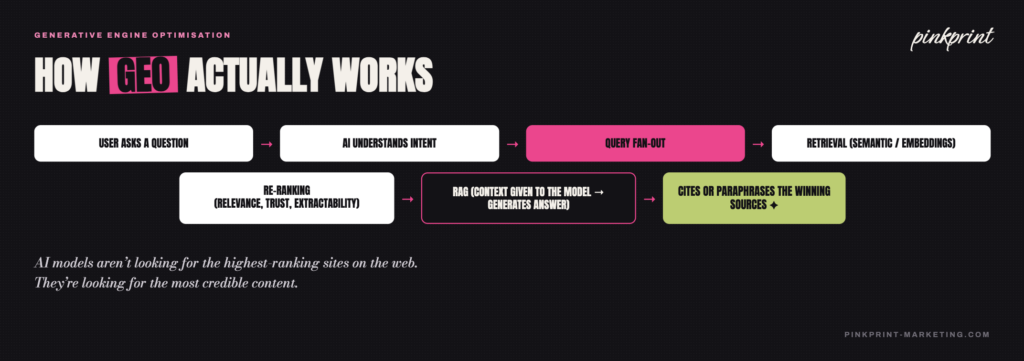
Every tactic in this guide exists to make your content perform better at one specific point in that chain. Entities and semantic clarity help at the retrieval stage. EEAT and originality help at the ranking stage. Clean structure helps at the generation and citation stage. If you’re ever unsure where to focus your effort, just ask: which link in this chain is my content actually weak at?
The Bottom Line
GEO isn’t here to replace SEO. Think of SEO as building your broad authority and GEO as making sure the AI engines actually notice and use what you’ve built.
So, is your content AI-ready, or is it about to get left behind?
FAQ
Is GEO replacing SEO?
Nope, and honestly, stop worrying about this one. GEO builds right on top of your SEO fundamentals, so it’s good to view this as just an additional layer.
Do I need to rewrite all my existing content for GEO?
Not even close. Start with the pages pulling in the most traffic and give those the glow-up first. Answer-first structure, schema, citability, FAQs, correct headings. Nail those before you even think about touching the rest of your library.
How long does it take to see results from GEO?
Honestly? It varies. But AI systems tend to re-crawl and re-index more frequently than traditional search, so you might see movement quicker than you’re used to. Three or four months of consistent tracking will tell you what’s actually working.
Can small businesses realistically compete with bigger brands on GEO?
Yes! And this is the part that should get you excited. GEO levels the playing field way more than traditional SEO ever did. AI models don’t care about your domain authority if you’re the one publishing the first-hand insight nobody else bothered to write.
A smaller site with genuinely original data can absolutely out-cite a much larger one running generic content.
Should I still write for humans, or am I basically writing for AI now?
Both. Always. Content that’s genuinely useful tends to perform well with human readers also performs well with AI retrieval systems. If you’re writing purely to game an algorithm, that’s exactly the kind of shallow content both Google and AI models are getting better at spotting.
Do I need technical SEO skills to do GEO well?
A tiny bit of technical SEO skills can go a long way. Crawlability, schema markup, site structure, that kind of thing helps. But most of GEO comes down to content quality and structure. Any strong content team can handle that without needing a developer on speed dial.
